Ewald R. Weibel, M.D.
Exploring the Structural Basis for Pulmonary Gas Exchange
Ewald R. Weibel, M.D.
Professor and Chairman of Anatomy,
University of Berne , Berne, Switzerland
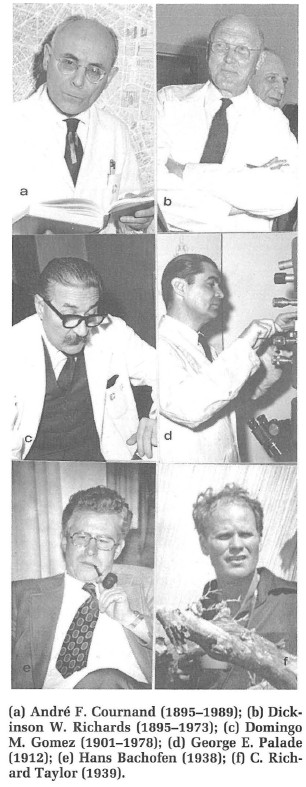
My story begins in the summer of 1959 when I joined, as a research fellow, the group of Andre F. Cournand and Dickinson W. Richards in the famous “C 6” Cardiopulmonary Laboratory of the Columbia University Division at Bellevue Hospital in New York City. This job had been offered to me in February of the same year following a seminar on the anatomy of collateral circulation to the lung that I gave at Bellevue on invitation by Andre Cournand. Relations between myself and Cournand had been strained because a year before, I had irritated Cournand-who had been awarded the Nobel prize in 1956 and clearly knew his worth by taking a fellowship with Averill A. Liebow at Yale University instead of with him. I had written to Cournand from Switzerland in 195 7 but never got an answer because, apparently, the U.S. Postal Service could not find this famous man in New York to deliver my letter. By the time I got a positive reply I had already committed myself to spending two years at Yale conducting experiments on the development of collateral circulation to the lung, a project in line with my previous research at the anatomy department in Zurich under the direction of Gian Tondury.
Andre Cournand was not a man to give up . Following my seminar he called me into the office of Dickinson W. Richards, Director of the First Medical Division, and bluntly said that I should leave Yale prematurely and come to work at Bellevue . Surprisingly, they offered me a substantial supplement to my modest fellowship, which was highly welcome because at Yale my wife and I lived in a shabby apartment without a bathroom and ate junk food like Chef Boyardee ravioli to make ends meet. But what really pushed me to take the job-and, in turn, irritate Averill Liebow was not the money but the task, for when I asked Cournand what he expected me to do, the reply was, “Do anything on the structure of the lung that is of interest for physiology.” My mind was immediately made up because that was such a tremendous challenge. Back at Yale I worked frantically to complete my experiments and write a manuscript, 47 and, in preparation for my work in New York, developed a method for lung fixation by formalin steam that would be “more physiological” than conventional fixation. 64 Then I bundled my things and travelled with my wife through the United States on a camping trip in our 1951 Nash (purchased for $200). I took up my job at Bellevue after Labor Day 1959, ripped of my last penny . Meanwhile, Domingo Gomez had arrived at the C 6 Laboratory. A Cuban refugee who had barely escaped with his life from Fidel Castro’s revolution and reign of terror, he found refuge with his old friend Cournand. They had been acquainted in their young years in France and then again when Gomez had worked with Homer Smith at New York University. Afterwards Gomez returned to Cuba on invitation by the then-dictator Fulgencio Batista to cre ate a Cuban Heart Institute, a project that never materialized. Gomez would prove to be the genius behind the work in which I was about to engage. A son of Cuban peasants, he had been sent by Batista to medical school in Paris, where he became a cardiologist and developed his extraordinary skills in mathematical reasoning. This training made him a biophysicist in the true sense of the word, one who would seek a rational explanation for life processes such as the circulation of blood, 21 the binding of 0 2 to hemoglobin, and gas exchange in the lung -and later even for social problems in public health. When I took on my new job I set up two laboratories, a small one in the pathology department to process specimens and serve as a link to morphology and one in the C 6 Laboratory to serve as a link to physiology. My equipment was modest but adequate, and it was all brand new because the laboratory had not done any morphology. I had a microscope, a microtome, some glassware, and later on a calculator. I par ticipated in some of the ongoing experiments and listened and
 talked to the maI1y senior and junior physiologists bustling about the place. This gave me new perspectives but did not help me find a worthwhile morphological project “of interest for physiology.” Cournand himself would be in and out of the place. It was his time of glory, when he was in great demand as a lecturer all over the world. And he certainly enjoyed it, as he later confessed in his autobiography He would come to the lab, stir up the crew, discuss all the projects, collect information and slides, and take off for the next lectures. The first question that sent me on my track was put to me by Domingo Gomez who wanted to know how many alveoli there were in the human lung. The ques tion was serious and pressing, for he needed the information to make calculations and predictions on gas exchange between air and blood. It also suggested the path for me to take: to provide sound quantitative information on the lung’s structure because the customary meticulous anatomical descriptions would not be of sufficient interest for physiologists. But what we later came to call “morphometry” was not yet invented, so information was rare. When I searched the literature I found estimates of alveolar number to range from 66 to 725 million, not to mention even higher values. It was evident that I had to obtain my own estimate, but no method was available for counting such microscopic entities on histological sections. I found out only much later that such a method had indeed been worked out in 1925 by the Swedish mathematician Wicksell, but his paper was too theoretical to be known among anatomists at that time. So, as a first project, Domingo Gomez and I set out to develop a method for counting alveoli on sections. We analysed theoretically the sectioning process, which presents, on sections, profiles of alveoli whose diameter would generally be smaller than that of the alveolus. The number of alveolar profiles counted on the unit area of microscopic sections, NA in contemporary symbolism, therefore de pended not only on the number of alveoli in the unit volume, Nv, but also on their size. We devised a formula that would allow Nv to be calculated from a count of NA and the estimation of the relative lung volume occupied by alveoli, Vv: The method required an estimation of the shape factor ~. which related alveolar volume and mean cross sectional area. We derived a “reasonable” set of values for ~ for different geometric shapes and used linear integration to estimate relative alveolar volume. But we then wanted to verify the method on some model specimen of known composition. For that purpose, we embedded a known number of peas and short segments of string beans into gelatin, cut the blocks with a sharp knife, and did the required measurements on the cut surfaces (Fig. to the left): the method gave a correct result! While we were doing this kitchen work in the laboratory next to the room where patients were being studied by cardiac catheterization, Cournand returned from one of his trips and stepped into the lab. He expressed utter consternation at our experimental object: “I did not hire you to study vegetable aspic,” he told us, and walked out. We were evidently in trouble, but when we eventually submit ted our method and the first estimates of alveolar number for the human lung obtained by a sound morphometric method to the Journal of Applied Physiology, 59 we included a photograph of our “vegetable aspic” to support the method and got it published (Fig. to the left):. The number of alveoli we determined, about 300 million in an adult human lung, is still an accepted figure . Today we realize that our method is only approximate and not unbiased; better methods are now available, but these improved methods have still not been used to estimate the number of alveoli in the human lung.
Read more: Ewald R. Weibel