John B. West M.D.
Dr. John B. West was Professor of Medicine and Physiology, University of California, San Diego, La Jolla, California. His scientific journey was shaped by diverse influences and experiences. Starting with a foundation in physics and chemistry in high school, he later transitioned to medicine due to his family’s medical background. His educational journey took him to England, where he discovered his passion for pulmonary physiology, driven in part by Julius Comroe’s influential book, “The Lung.”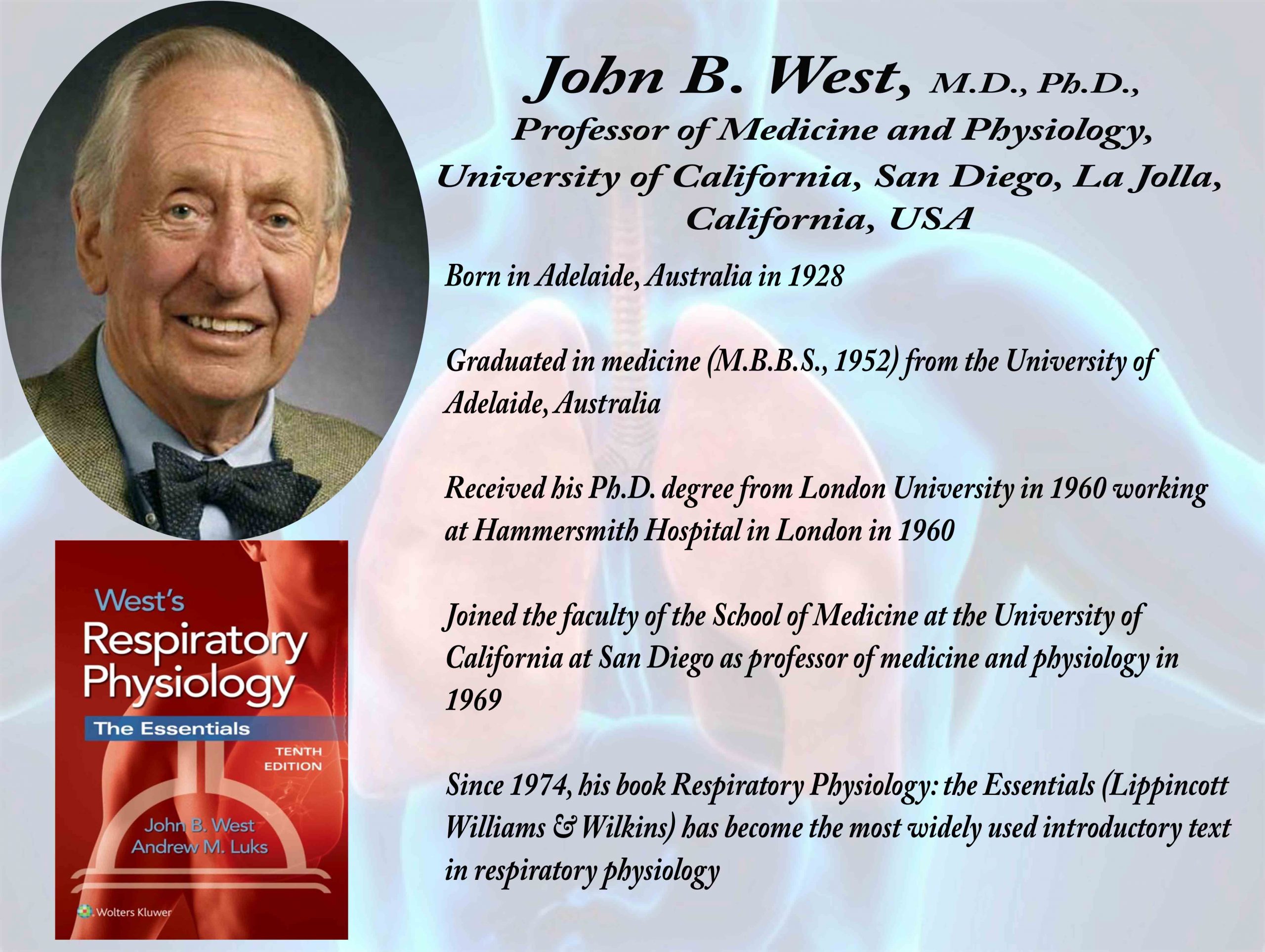
Dr. West’s research made significant contributions to our understanding of pulmonary physiology. He revealed uneven blood flow distribution in the lungs, challenging existing knowledge and sparking investigations into factors contributing to blood flow and ventilation inequality. His work involved the use of innovative techniques like mass spectrometers and medical cyclotrons.
One of his key discoveries was the demonstration of structural damage in the blood-gas barrier under high capillary pressures. This was achieved through research using anesthetized rabbits and various pressure conditions, with electron microscopy revealing disruptions in capillary endothelial and alveolar epithelial cells.
The forces involved in maintaining the strength of pulmonary capillaries were explored, including hoop tension, surface tension, and longitudinal tension. Stress failure in these capillaries was found to be associated with high capillary pressures and a unique extracellular matrix primarily composed of type IV collagen.
These findings have significant physiological and pathophysiological implications, particularly in conditions such as neurogenic pulmonary edema, high-altitude pulmonary edema, and certain cases of the adult respiratory distress syndrome, where increased capillary pressure leads to high-permeability pulmonary edema, often linked to stress failure of pulmonary capillaries.
Overall, Dr. West’s work has greatly contributed to our understanding of pulmonary physiology and its role in various pulmonary conditions, shedding light on the intricate balance between strength and function in the pulmonary capillaries.
Read his article on Strength and Failure of Pulmonary Capillaries